The first release I ever put out landed with a thud, and it took me a while to understand why.
The music was ready. The problem was timing. By the time the master came back final, I had left myself about a week before release day, and a week is not enough. There was no time to set up a proper pre-save, no runway for a pre-order, and no lead time to be considered for an editorial playlist. The song came out to almost no one, for reasons that had nothing to do with the song.
Here is the lesson I wish someone had handed me. The release date is not your deadline. It is the finish line. A good music release timeline is built backward from that finish line, and the real work all clusters weeks in front of it. Plan forward from today instead, and you will keep discovering those deadlines too late to use them.
So let me lay the timeline out the way it actually works, counting backward from release day.
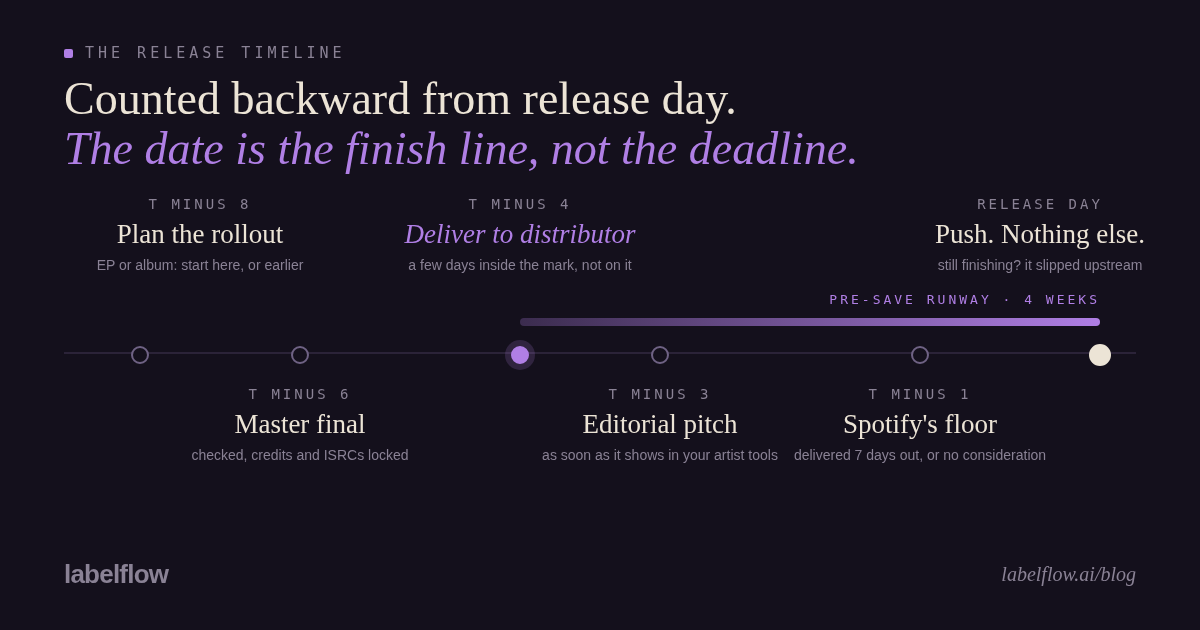
Release day is the finish line, not the deadline
By the time your song goes live, almost all the real work is behind you. Release day is for pushing: posts, outreach, thanking the people who showed up. If you are still finishing anything on the day itself, something upstream went wrong. The whole point of a timeline is that release day gets to be calm.
Work backward, and the deadlines that actually matter start to appear.
Four weeks out: deliver to the distributor
This is the anchor the whole plan hangs on, and it is the one people get wrong. You want your finished release, final master, final artwork, all the metadata and credits, delivered to your distributor about a month before release day.
Technically, most distributors can turn a release around faster than that. Spotify's own floor is even lower: the music has to be delivered at least seven days before release for editors to consider it at all. That is exactly why people cut it close. But the technical minimum is not the point. The month is not for the distributor. It is for you.
Why a month, not a week: the pre-save runway
Delivering four weeks out is what buys you the two things that actually drive a first week, and both of them need lead time.
The first is the pre-save and pre-order campaign. You cannot generate a pre-save link until your release is registered and dated with the distributor. Once it is, that link becomes the center of your entire pre-release push: every post, every story, every "out in three weeks" points at it, quietly collecting saves and pre-orders that convert into day-one streams. A pre-save campaign that runs for three or four weeks can meaningfully change your opening. One you throw up two days before release does almost nothing. Deliver late and you do not just risk the date, you forfeit the runway.
The second is editorial. The playlist teams at Spotify and Apple want your release in their system with real lead time so they can actually consider it. Seven days is the floor. The labels I see get placements pitch three to four weeks out, as soon as the release shows up in their artist tools. Pitch too close to release and you have taken yourself out of the running before you started.
Four weeks is the number that lets you do both properly. It is the difference between a release that arrives to a warmed-up audience and one that arrives to silence.
Deliver with a buffer, and thank yourself later
There is a version of this where you hit the four-week mark to the exact day, and it works right up until it does not. A wrong ISRC, a misspelled feature credit, artwork at the wrong resolution. Catch one of those after your pre-save link is already live and being shared, and you are untangling a mess in public.
So I treat four weeks as the target and aim to deliver a few days inside it. That buffer is not wasted time. It is insurance on the link your whole campaign is about to point at.
Six to eight weeks out: finish the music, start the plan
This is where the master gets finalized and checked, and where the rollout takes its shape. What goes out, when, to whom, and what the story is. For a single, six weeks of total runway is usually enough. For an EP or album, give yourself more like eight to twelve, because there is more to coordinate and more editorial lead time to respect.
None of this is exotic. It is just a lot of small things that each have to happen in the right order.
The part that actually makes this hard
Here is what no checklist tells you. You are almost never running one release. You are running several, each at a different point on this same countdown, all at once.
As I write this, DEEP TALES has three releases on the countdown: one that came out in June, one that came out in August, and one that comes out tomorrow. Between them they carry 73 deliverables. The August one alone has 30, and its first deliverable was due nine weeks before release day. Its last one is due seven weeks after. The countdown does not even stop at the finish line. It just changes what it is counting.
Holding all of those clocks in your head at the same time is the real job, and it is exactly where things slip. Not because any single task is hard, but because there is so much of it, moving on so many different timelines, with only one of you to remember it all.
That is why a release timeline belongs in a system, not your memory. You should be able to enter the release date once and watch every upstream deadline fall into place on its own: the distributor delivery, the pre-save launch, the editorial pitch, the asset lock, each arriving when it needs to instead of when you happen to remember it.
That is exactly what I built Labelflow to do, because I got tired of rediscovering these deadlines the hard way. If you want the fuller story of why I started building it, that is the first post in this series.
Plan backward from the date. Protect that four-week delivery above all else. And get the timeline out of your head and into something that will not forget.